Went to the Barbican last night to see Napoli, Napoli, Napoli, the new film by the maverick U.S. director Abel Ferrara, a man whose public persona can best be described as (to quote one recent blogger) “batshit crazy”.
He was present for a Q&A session afterwards, together with several of his collaborators on the film – which is a documentary about Naples, featurng interviews with inmates of the city’s Pozzuoli women’s prison, as well as re-enactments scripted and performed by Neapolitan writers and actors including Peppe Lanzetta, Gaetano Di Vaio, and Maurizio Braucci.
Now, directors’ Q&As are usually sedate affairs. A deferential chairperson says complimentary things and asks questions to which the director makes smooth, intelligent replies. The audience ask more questions, which are either further compliments or film-student allusions designed to show off. Someone always asks what the director is working on next, and he or she evades this question urbanely. It ends with fervent applause, and satisfaction all round.
Last night was different. The film itself is brilliant, confrontational, often moving, and completely absorbing – more for its extraordinary interviews than for its embedded mini-dramas. The women of Pozzuoli are honest about the crimes that landed them inside: thefts, muggings, burglaries and above all drugs. Some are addicts; some took the rap for husbands or offspring, and others just seem unsure what went wrong. Most emphasise how little choice they had: they live in brutal housing developments in areas with 80 percent unemployment, and when they come out of jail they have even less to go back to than before. One of the most affecting interviews was with a woman from Nigeria, who had come to Europe to earn money for her family, but had to pay back her debt to her people-traffickers, and was given a choice between prostitution and drug-dealing. “So how do you find life in Italy?” asked the interviewer (Gaetano Di Vaio, a man who himself spent years as a Naples prison inmate). “How can I say?” she replied with tears in her eyes. “I have been here five years, and have spent four years in prison. I just don’t like to say.”
After the film came the Q&A. A troupe of writers and actors arrived on stage, seven people in all, including a very personable chairman, William Ward, and Abel Ferrara himself. He shambled into view like Charles Bukowski on a bad-hair day. Sitting down and dragging his chair forward so everyone else was a pace or two behind him on the stage, he pulled out a handful of loose change and jangled it nervously throughout the session, dropping a coin every so often.
The others found seats as best they could and tried to sort out who was translating what and for whom. (In the end, Ward did most of the translating himself.) The questions began – and good questions they seemed to be too, except that within five minutes they had been swept away by an atmosphere of chaos. Whenever a question was put to Ferrara, he would reply by yelling “Ask him!” and pointing to one of the others. If it was put to someone else, he would interrupt loudly, or emit loud barks of laughter. It was messy and fascinating.
There seemed to be no time for audience questions – until a loud voice arose from the back of the cinema. “I have to say this now, because I am going home soon and if I don’t say it before I go, I will have a nervous breakdown.” (I’m reproducing all the dialogue as best I recall it.) “The Mau Mau [a slang term for the crminal poor of Naples] – The Mau Mau in the film: that is me. My mother is in that prison. Now you go in and you spend two months in the city. What can you know about it? You “give a voice” to someone who already has a voice, and .. ”
Abel Ferrara: “WHAT? What did you say?”
Man: “You give a voice to someone who already has a voice!”
Abel Ferrara (almost rising out of his seat): “What is this shit!?” And, as the questioner continued, in English, he began yelling “Speak Italian! Speak Italian!” and pointing to Gaetano Di Vaio– “Speak Italian so he can understand! A film is not made by one person! He wanted to make the film. He brought me in to help.”
“I don’t want to speak Italian. I want to finish my point,” said the man – and now other audience members weighed in as well. One woman, standing on the stairs, shrieked louder than anyone. “Speak fucking Italian!” yelled Ferrara meanwhile. Di Vaio could be seen whispering “Eh?” and making the Italian “What the hell is going on?” gesture with pinched thumb and forefingers to his translator, who struggled to keep up.
The whole of the back row seemed to be surging to its feet and shaking its fists in the air. It looked as though there was going to be a surge of protesters down the stairs – if Ferrara didn’t charge up them first. William Ward tried, in his nicest way, to bring it under control. Barbican officials appeared on the sidelines and made urgent throat-cutting movements. “Ahem, well,” said Ward, “I’m afraid that’s all we have time for.” Ferrara swore and raved. “Time is running short, unfortunately,” said Ward.
At last, the microphone was taken by Peppe Lanzetta, one of the authors and actors in the film, and a man who had so far contributed not a word to the discussion. Quiet, solid, calm, shaven-headed, unflappable, Lanzetta said: “This is a film. Abel Ferrara makes cinema. He is cinema. Cinema is art. And art does not have to justify itself. A work of art just is. You can like it, or not, but a film is there, and that is that.”
This got a great round of applause. And somehow, eventually, we did what audiences normally do at these events. We filed out, chatting. We stood around outside, we had glasses of wine, and then we went home.
The excitement of the Q&A seemed at first to be taking over from the film, and I felt moved both by the intensity of the audience man’s objection (no wonder he felt that way!) and by Lanzetta’s defence of art. Waking up this morning, though, I find it’s not the debate but the film itself that stays with me.
Especially the women. They spoke simply; they often smiled, and many of them were missing teeth. I suspect this didn’t come from eating too many sweets. I think they had been hit, a lot, by many people. They all had their stories to tell, and they very definitely told them in their own voices.
Saturday, April 24, 2010


Monday, April 19, 2010
Infinity and utopia in Brighton
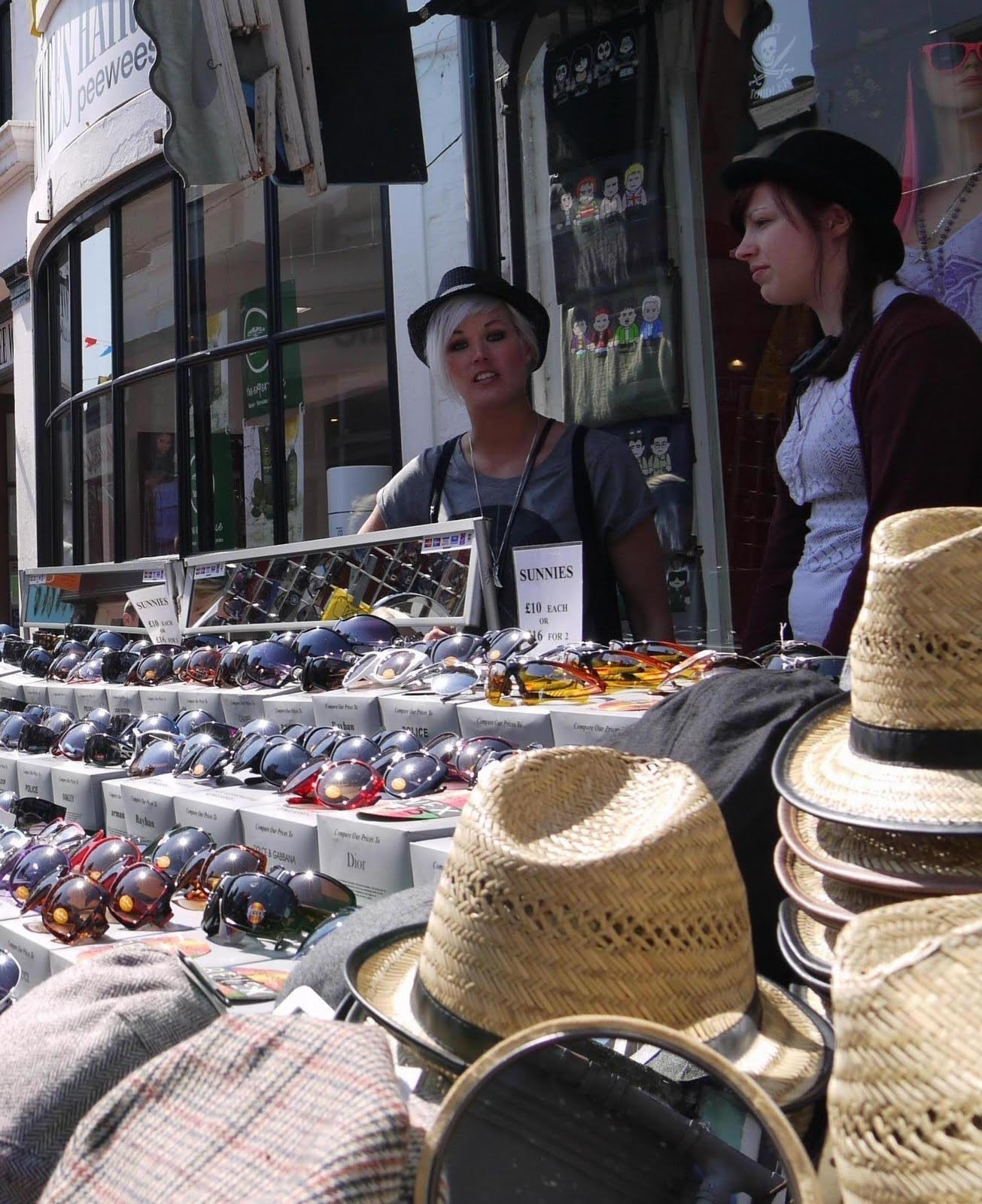
Some more street photography, this time done while walking through Brighton to my friend's birthday party. Thus these were all taken with a big bunch of flowers tucked in one elbow crook and a bottle of wine in a bag ...




Thursday, April 15, 2010
Stand-up comedians
The other day I saw my first real live stand-up comedian - Sean Lock, and very funny he is too.
I don't know how I got to this age without having had this experience before, but I'm amazed at the bliss and luxury of it. You just lean back in your seat, and someone comes along and puts all their energy into making you laugh for two hours. Why isn't all of life like that?
I don't know how I got to this age without having had this experience before, but I'm amazed at the bliss and luxury of it. You just lean back in your seat, and someone comes along and puts all their energy into making you laugh for two hours. Why isn't all of life like that?
Saturday, March 27, 2010
Secret chocolate agents
Yesterday, I had my first adventure with a group called London Photographic Explorers.
The idea is this. A number of you meet up in the vicinity of some interesting scene. You synchronize your watches, get out your cameras, and disperse like secret agents into the crowd to take photos. Some will take four or five beautiful, professional images of luminous beauty. Others (me) snap up a mish-mash of scraggily composed, poorly-focussed rubbish and hope to sort out a few accidental gems afterwards. An hour or so later, you re-meet to see what you got.

Yesterday, the assignment was the Chocolate Festival behind the Royal Festival Hall.
I've never done anything like this before. I couldn't even stay for the "show and tell" part yesterday, as I had a book group to go to (they were talking about my book - a first for me!). But even during that half-hour dip into the world of photographic explorers, I was amazed at how liberating it was.
 Sneaking photos of people in crowds is always great. It opens up ideas for stories or characters, it makes you curious about other lives, it lets you be downright nosy. Unaware of you looking at them, people are ugly, beautiful, cool, funny, pensive, or bathed in a spiritual light (even if it's just a street lamp). But normally I'm so shy and furtive about what I'm doing that the shots come out a blur. By the time the shutter closes, I'm already ducking behind a parked car or simulating interest in a completely different scene in the opposite direction. My pictures turn out to be of people's backs: less embarrassing, but it doesn't make for good shots.
Yesterday, instead, I relaxed. This mission was nothing to do with me: it was just a job I'd been given. My alibi was perfect. I had my sense of entitlement. It was as if I was wearing an "Authorised Photographer" badge that only I could see - so I got on with the job.
Also, I knew I wasn't alone. Every now and then, as I roamed (we were all separately circling the clump of chocolate stalls, like sharks circling a raft of shipwreck survivors), I'd pass another agent. We'd give a sign: a smile, a lift of the eyebrows, a waggle of cameras. Sometimes we'd speak: "Having fun?" - "Getting any good ones?"
And no one noticed. They just kept eating their chocolate...
 Of course I did have some chocolate too.
The idea is this. A number of you meet up in the vicinity of some interesting scene. You synchronize your watches, get out your cameras, and disperse like secret agents into the crowd to take photos. Some will take four or five beautiful, professional images of luminous beauty. Others (me) snap up a mish-mash of scraggily composed, poorly-focussed rubbish and hope to sort out a few accidental gems afterwards. An hour or so later, you re-meet to see what you got.

Yesterday, the assignment was the Chocolate Festival behind the Royal Festival Hall.
I've never done anything like this before. I couldn't even stay for the "show and tell" part yesterday, as I had a book group to go to (they were talking about my book - a first for me!). But even during that half-hour dip into the world of photographic explorers, I was amazed at how liberating it was.

Also, I knew I wasn't alone. Every now and then, as I roamed (we were all separately circling the clump of chocolate stalls, like sharks circling a raft of shipwreck survivors), I'd pass another agent. We'd give a sign: a smile, a lift of the eyebrows, a waggle of cameras. Sometimes we'd speak: "Having fun?" - "Getting any good ones?"
And no one noticed. They just kept eating their chocolate...

Tuesday, March 2, 2010
Thursday, February 25, 2010
Autonauts of the Cosmoroute
I love odd, funny, plotless, personal books, and have just finished reading one of the best I’ve ever encountered.
Autonauts of the Cosmoroute, by Julio Cortázar and Carol Dunlop, was first published in 1983 in Spanish, but for some reason no English translation appeared at the time. It has now very belatedly been translated, by Anne McLean, and published in the UK by Telegram.

Julio Cortázar is a novelist and short-story writer I had never read before. (I will now.) He wrote somewhat Borgesian tales and fables, I think. But this book is different. It relates a journey he made with his partner Carol Dunlop from Paris to Marseilles in May 1982: a straightforward journey down a single motorway – but with one catch. Driving in a VW camper van, they stopped at every single rest area on the way, alternating between one stop for lunch, and one stop overnight. Thus, they travelled only the distance of two rest stops per day, and it took them a month to get to Marseilles. All month, they never allowed themselves to leave the weird interzone of the Autoroute du Sud. Friends brought them fresh vegetables and fruit every so often, so they wouldn’t get scurvy. Otherwise they lived on service-station food, with the occasional motel stop. Then, together, they wrote a book about it.
The journey was a piece of performance art, really, but it has nothing pretentious about it. If done by someone like Baudrillard, it would have been posy, and it would contain meditations on the philosophical meaning of it all. Instead, it is simply funny and charming. The pages are filled with photographs, mostly of the couple themselves and of their camper van, whom they called Fafner after Wagner’s dragon. They also write about – and photograph – their hideous folding picnic chairs, the “florid horrors”. We see the strange flora and fauna they meet in the rest areas, and meet other travellers, who eye them suspiciously. Every so often, we get an imaginary letter from a woman who – the couple fantasize – travels regularly on the motorway, and who gradually realises that she is seeing the same peculiar couple at a different spot every time. Surely they are not living on the motorway, wonders the woman? Are they ghosts? Have they been there forever? Will they ever leave?
The best character is Fafner, who disports himself in the book regularly, sometimes with his dragon-crest in full flare (that is, with his tent-roof up), or his wings flapping (doors open), or adorning his sides with shadows (parked under a tree in sunlight), or allowing himself the indignity of being draped with laundry. I have my own reasons for being attached to VW vans, so perhaps that’s why I like it.
The book could so easily have gone wrong, but it is gentle and charming, and in its own way it does offer a form of philosophy. Its philosophy is never to philosophise, but simply to observe the little things, to let your imagination go, and to have fun. It is also an ode to companionship. The story is given a poignant twist by a revelation at the end about one of the two travellers. (The two human ones, that is. Fafner is clearly a traveller too, and even the florid horrors seem to be having a laugh.)
It is much less like a Baudrillard book than a novel by Jerome K. Jerome. This is a daft, perverse, companionable trip done purely for its own sake; a pilgrimage whose only goal is itself. It goes immediately into my list of favourite books: the sort I will read again and again, and which I wish I had thought of writing myself.
Autonauts of the Cosmoroute, by Julio Cortázar and Carol Dunlop, was first published in 1983 in Spanish, but for some reason no English translation appeared at the time. It has now very belatedly been translated, by Anne McLean, and published in the UK by Telegram.

Julio Cortázar is a novelist and short-story writer I had never read before. (I will now.) He wrote somewhat Borgesian tales and fables, I think. But this book is different. It relates a journey he made with his partner Carol Dunlop from Paris to Marseilles in May 1982: a straightforward journey down a single motorway – but with one catch. Driving in a VW camper van, they stopped at every single rest area on the way, alternating between one stop for lunch, and one stop overnight. Thus, they travelled only the distance of two rest stops per day, and it took them a month to get to Marseilles. All month, they never allowed themselves to leave the weird interzone of the Autoroute du Sud. Friends brought them fresh vegetables and fruit every so often, so they wouldn’t get scurvy. Otherwise they lived on service-station food, with the occasional motel stop. Then, together, they wrote a book about it.
The journey was a piece of performance art, really, but it has nothing pretentious about it. If done by someone like Baudrillard, it would have been posy, and it would contain meditations on the philosophical meaning of it all. Instead, it is simply funny and charming. The pages are filled with photographs, mostly of the couple themselves and of their camper van, whom they called Fafner after Wagner’s dragon. They also write about – and photograph – their hideous folding picnic chairs, the “florid horrors”. We see the strange flora and fauna they meet in the rest areas, and meet other travellers, who eye them suspiciously. Every so often, we get an imaginary letter from a woman who – the couple fantasize – travels regularly on the motorway, and who gradually realises that she is seeing the same peculiar couple at a different spot every time. Surely they are not living on the motorway, wonders the woman? Are they ghosts? Have they been there forever? Will they ever leave?
The best character is Fafner, who disports himself in the book regularly, sometimes with his dragon-crest in full flare (that is, with his tent-roof up), or his wings flapping (doors open), or adorning his sides with shadows (parked under a tree in sunlight), or allowing himself the indignity of being draped with laundry. I have my own reasons for being attached to VW vans, so perhaps that’s why I like it.
The book could so easily have gone wrong, but it is gentle and charming, and in its own way it does offer a form of philosophy. Its philosophy is never to philosophise, but simply to observe the little things, to let your imagination go, and to have fun. It is also an ode to companionship. The story is given a poignant twist by a revelation at the end about one of the two travellers. (The two human ones, that is. Fafner is clearly a traveller too, and even the florid horrors seem to be having a laugh.)
It is much less like a Baudrillard book than a novel by Jerome K. Jerome. This is a daft, perverse, companionable trip done purely for its own sake; a pilgrimage whose only goal is itself. It goes immediately into my list of favourite books: the sort I will read again and again, and which I wish I had thought of writing myself.
Tuesday, February 23, 2010
Different tones
“Our life is composed, like the harmony of the world, of contrary things, also of different tones, sweet and harsh, sharp and flat, soft and loud. If a musician liked only one kind, what would he have to say? He must know how to use them together and blend them.” Montaigne, "Of Experience".
Subscribe to:
Posts (Atom)

 Posts
Posts


